AI reveals how well the organisation really understands itself
Reflections from the first KI Norge Dialog — AI-ready data, context and leadership
KI Norge Dialog focused on AI-ready data. Yet the day points to something broader: how well the organisation understands its data, concepts, processes and decision basis — and its ability to turn that into practice.
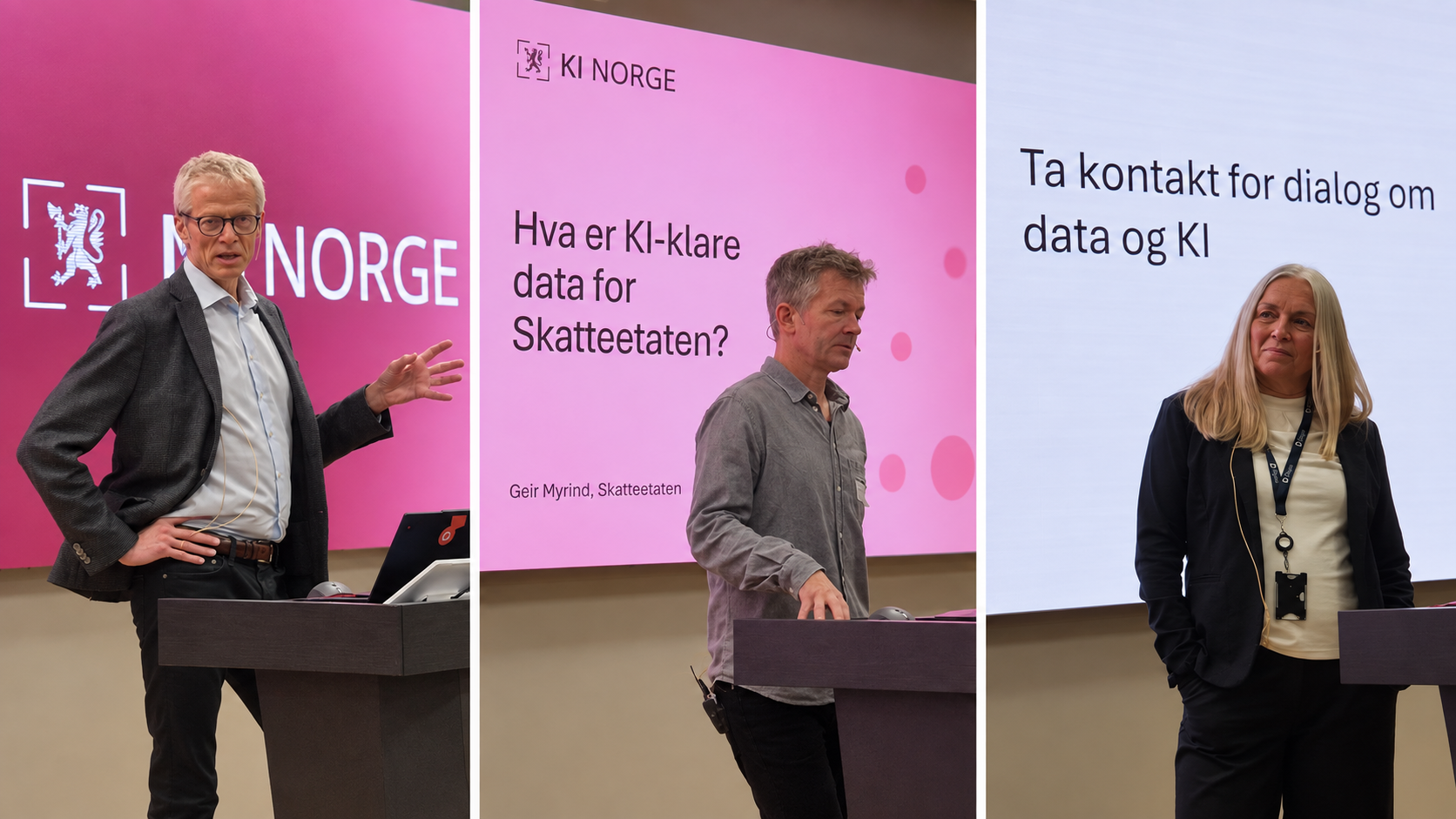
The first KI Norge Dialog meeting on 7 October was formally about AI-ready data. Yet I left with a broader reflection. AI does not only make organisations more efficient. It reveals how well they understand their own data, concepts, processes and decision basis.
Hans Christian Holte, head of KI Norge, opened the day. He described the meeting as a first step towards an arena where relevant AI topics can be discussed, experiences shared and KI Norge can learn from environments working on these issues in practice. The ambition was not only to inform, but to create dialogue and a professional community that can help Norway succeed more with AI.
Marte Kjelvik from Digdir and Geir Myrind from the Norwegian Tax Administration then showed, from each their perspective, how AI moves data governance from a relatively narrow discipline to a clear leadership and business theme. When AI must work across CRM, ERP, case handling, documents and legacy systems, old weaknesses become visible. Different definitions, weak data models, missing documentation and unclear ownership affect the quality of answers, decisions and automation.
AI does not care about our system boundaries
Consider a seemingly simple question. What do we know about this customer?
For a business, the answer may sit across CRM, finance systems, documents, email and case management. For AI, these are not five organisational boxes, but five information sources that must be understood together.
That is where the challenge begins. “Customer” may be defined differently across systems. Identifiers may vary, data may be updated at different times, and information may have been collected for different purposes. AI does not remove these differences. When information is used across boundaries, they become more visible.
This points to an important shift from system-centric to more data-centric thinking. Data must be treated as an enterprise resource that can be understood and governed across systems, not only as something that belongs to a particular application.
AI-ready data is about more than data quality
Marte presented data governance at three levels. Strategically it is about direction, ambition and how data supports business goals. Tactically it is about organisation, roles, accountability and priorities. Operationally it is about execution — including data quality, metadata, access, classification and documentation.
This matters because many AI initiatives start at the opposite end. A model or tool is chosen, and use cases are searched for afterwards. The message of the day was more grounded: start with the need and purpose, then determine which data, roles, rules and technologies are required.
A recurring framework was the FAIR principles.
F – Findable – data should be discoverable
A – Accessible – data should be reachable
I – Interoperable – data should be understandable and usable across contexts
R – Reusable – data should be reusable
The point is that technical access is not enough. The recipient — whether a person, another system or AI — must understand what the information means, where it comes from, how current it is and which conditions apply to its use. FAIR should therefore be built in from the start as far as possible, not repaired when sharing needs arise later.
Context becomes part of AI infrastructure
Geir Myrind made the issue concrete through the Tax Administration's work. His starting point was that data alone is not enough. The organisation also needs knowledge about the data, and that knowledge must be governed so that both people and machines can use it.
That includes concepts, information models, code lists, legal metadata, data quality, ownership and metrics. The Tax Administration describes this as a knowledge layer between the data and their use. In simplified terms: data → knowledge → serving → use. Data and context can then be made available through APIs, MCP, data contracts, access mechanisms and search, so reports, analytics and AI agents have a stronger foundation to work from.
This also changes the role of metadata. Metadata is not only documentation produced for compliance, but part of the infrastructure that makes AI more precise and auditable. Geir put it well: “If you document for colleagues, you document for the AI.”
When the same word means different things
The Tax Administration examples showed how practical this becomes. The term “settlement” can mean different things in VAT, accounting rules, tax payment and electricity supply. None of the definitions need be wrong. The problem arises when meaning does not travel with the information.
A glossary therefore does not have to force one definition. It can document which meaning applies in which domain, who owns the definition and where it comes from.
The same applies to code lists. A municipality number may be obsolete, stored without a leading zero or mean different things across systems. Without good code lists, the analyst must interpret what is meant. The presentation summed up the risk precisely: “The analyst guesses. AI guesses faster.”
What are we actually measuring?
The issue also applies to KPIs and decision basis. Two reports may show different figures for “active cases” while both are technically correct. One may count cases that are not closed; another counts cases with activity in the last 30 days.
Then the problem is not primarily data quality. The problem is the definition. With documented metrics and traceability back to the source, AI can explain why figures differ, rather than having to choose between them. See also From data to decision.
For leaders this is more than a data problem. AI cannot improve decision support if the organisation has not clarified what it measures, which definition applies and which data should steer action.
From AI-ready to “X-ready” data
Geir also nuanced the term AI-ready data. The same principles apply whether information is used for reporting, analytics, BI, machine learning, AI agents or new data products. Hence the idea of “X-ready data”.
The questions are the same. Which datasets matter? What do key concepts mean? How is data structured? Which legal frameworks apply? What do we know about quality, storage, refresh frequency and ownership?
That is an important strategic point. AI readiness should not be treated as an isolated AI programme. Good data governance makes the organisation better prepared for many use cases, including those we do not yet know. In that sense, AI-ready data is as much about general change and development capability as about AI itself.
From need to action
After the talks we moved into a workshop. The model followed a simple sequence: need, user and value, data, status and barriers, what must be in place and first steps. The order is telling because technology does not come first.
At our table the discussion started broadly on productivity in the public sector and how technology can free capacity, including in health and elder care. Gradually it turned towards people, change and value realisation.
It is not enough that a solution is technically better. Ways of working must change, someone must take responsibility, and leadership must be willing to capture the benefit through better services, higher capacity, lower costs or other measurable outcomes.
The question of baseline also came in. If we do not know how the process works before the change, we do not know whether the initiative improved anything. Implementation is not the same as value realisation. Our table also concluded that people and the change process itself deserve an even clearer place in the model.
Trust and resistance are part of execution
After the workshop I continued the conversation with Birthe Nesset, who researches trust between people and advanced intelligent systems. She described trust through the interplay of system, person and the environment around the interaction.
It is a useful reminder that even a technically sound solution can fail if users do not understand it, trust it or feel it fits everyday work. This becomes especially important when efficiency affects established roles and tasks. A change can be rational for the organisation and still feel threatening to the individual.
This matches leadership experience I often see in transformation work. Technology is rarely the hardest part. The challenge more often lies in changing ways of working, building trust, clarifying accountability and creating enough safety and understanding for people to adopt the solution. And when it works, leadership must also be willing to realise the benefit.
AI as a leadership test
For me the day therefore leaves a clear chain:
Need → value → data → context → accountability → ways of working → adoption → realised effect
AI is a powerful enabler within that chain, but it replaces none of the links.
We can buy platforms, build agents and connect ever more data sources. Technology alone still cannot decide what data means, which quality is good enough, who is accountable or which value the organisation should create.
That may be the most interesting leadership test in the development we are in. AI reveals not only the quality of our data. It reveals how well the organisation understands itself — and how well we turn that understanding into new practice and real value.
#ArtificialIntelligence#Leadership#DigitalTransformation#DataGovernance#Strategy
Relevant next steps
If you would like to discuss a related topic, feel free to get in touch.
Go to contact →