Better data. Better decisions.
From Digital Norway's Tech breakfast: Orkla on the flywheel for becoming data-driven, and the Norwegian Public Roads Administration's Risikokurve — machine learning that makes it possible to prioritise measures where
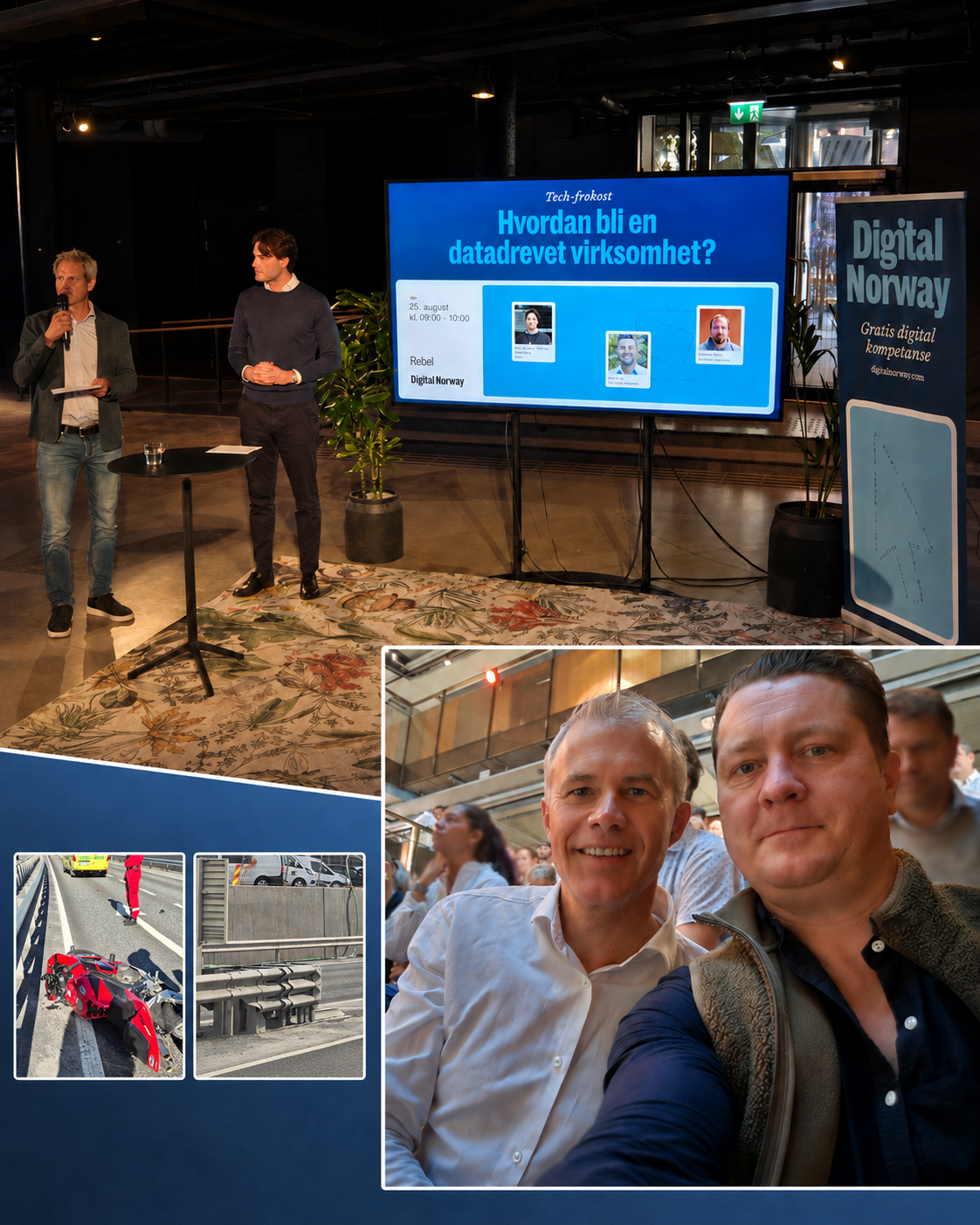
Sometimes it can save lives.
At Digital Norway's Tech breakfast today, Orkla Home & Personal Care and the Norwegian Public Roads Administration showed two different, but very concrete, paths towards becoming more data-driven.
Technology is the foundation. Value arises when data influences decisions, work processes and priorities.
Orkla and the flywheel
Hans-Martin Thorsby Gjermstad described implementation, integration and innovation as three mutually dependent parts of the same flywheel.
Implementation ↔ Integration ↔ Innovation ↔ Implementation
The point is not the sequence, but the interaction. Each part affects the other two.
Culture and competence. Cross-disciplinarity. Measurable value. Prioritisation. Scaling. And the ability to challenge the work process itself, not just create a faster version of what you already do.
I also liked the point about balancing quick wins that create energy with larger initiatives that require more change capacity and can have a significant effect on the bottom line.
The Norwegian Public Roads Administration and a clear why
Johan Fu and Anders Eggum started from a completely different place.
«Everyone should get home.»
Vision Zero is about zero killed and seriously injured on Norwegian roads.
Through Risikokurve, which won the Digitalisation Award 2026, the Norwegian Public Roads Administration uses machine learning to analyse more than 100,000 curves. Around 9,000 are flagged in different risk categories, so that specialists can prioritise inspections and measures more effectively.
Data does not replace professional expertise. It makes it possible to use that expertise more precisely.
This also struck me personally.
This spring I crashed on a motorcycle on the E18 in Oslo and hit the crash barrier that functions as a median divider. I got home that day, after a visit to the emergency clinic. I was lucky. The motorcycle could not be saved.
That is why the Norwegian Public Roads Administration's talk was particularly interesting. Risikokurve shows how data, machine learning and professional expertise can be used to find exposed locations and prioritise measures with the greatest effect.
At the place where I crashed, there is still no extra protection in front of the exposed steel structure.
When the Norwegian Public Roads Administration itself highlights the risk for motorcyclists at crash barriers and roadside terrain, I hope the work also leads to more concrete improvements. Rubber-based or other energy-absorbing protection should be worth considering where it is appropriate from a road safety perspective.
For me, this shows what data-driven development can mean in practice. A better basis for decisions, more accurate priorities, and in the extreme, more people who get home safely.
That is also the strength of this kind of meeting. Concrete experience from organisations that turn data and technology into better decisions and results.
It was also good to share breakfast with Thomas Holm, a fellow student from the BI course Generative AI for Business. Yet another opportunity to discuss how data and AI move from technology to value creation in organisations.
#Datadrevet #AI #DigitalTransformasjon #Ledelse #Verdiskaping
Relevant next steps
If you would like to discuss a related topic, feel free to get in touch.
Go to contact →