Dad first. Coach afterwards?
Motivation, trust and psychological safety at home and on the tennis court: when is it more important to be a dad than a coach — and what happens when your own ambitions overshadow the kids’ joy?
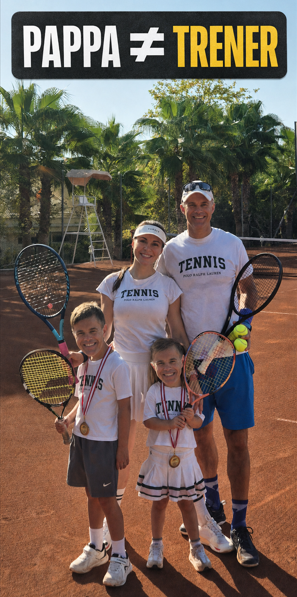
Over the past week I have written about motivation, trust and psychological safety. Topics we often talk about in leadership, but which may matter even more at home.
What happens when you want to motivate, but create pressure? When you want to help, but take too much space? And when your child needs safety more than correction?
For me this also hits the tennis court. 🎾
I have played tennis almost my whole life, and I still play quite a lot.
I am also a trained tennis coach, and perhaps best of all: I get to share the sport with my family. Both my wife and our children, almost 5 and 7, play tennis. 👨👩👧👦
There is something very fine about that. But also something demanding.
Tennis is a fantastic school for life, and chasing a dream is beautiful. But a parent’s job is first and foremost to believe in their child, not to put pressure on them or live the journey for them.
If I am completely honest, I have felt pride when the kids succeed. But I have also felt frustration, and a bit of irritation, when it does not go quite as well. And that may not be so great. 💣
Perhaps that is why the question struck me when I saw the reflection that Novak Djokovic does not want to coach his own children. No comparison intended, but the thought is interesting: Maybe it is more important to be a dad than a coach.
At the same time, this is not black and white. Norway’s best tennis player of all time, Casper Ruud, has his father as coach. Many elite athletes have had parents as both supporters and coaches on the way to the top.
Perhaps that shows the question is not whether parents can be coaches, but 𝑤ℎ𝑒𝑛, ℎ𝑜𝑤 and ℎ𝑜𝑤 𝑙𝑜𝑛𝑔 it is right.
USTA describes the parent role in tennis first and foremost as support, safety and unconditional backing. Research also points out that the parent–coach combination can bring both quality time and motivation, but also role confusion, pressure and conflict.
And perhaps some of this is also age-related.
When children are small, it can be completely natural for a parent to introduce the play, the movements and the joy of the sport. But over time, the relationship may be best served when others take a clearer coaching role.
By the way, the image for this LinkedIn post is a bit playful. I have put my own face in front of the kids’. It is meant to say something about how easy it is to project your own ambitions onto them. Or how high expectations you may end up setting, because you have always set high demands on your own development.
In any case, it is a useful reminder for me.
I love tennis.
I love that my family does too. 💯
But perhaps my most important task is not to develop their strokes.
💙 Of course it is to preserve the joy. ❤️
👉 What do you think?
Is it a strength or a pitfall when parents are also coaches?
And does this change with age?
#tennis #parenting #sportjoy #mastery #development #leadership
Relevant next steps
If you would like to discuss a related topic, feel free to get in touch.
Go to contact →