Is your commercial operating model rigged for 2026?
Reflections from iteam's breakfast seminar: AI as a new operating system, cyber security as a foundation and agents that actually do work.
Is your commercial operating model rigged for 2024?
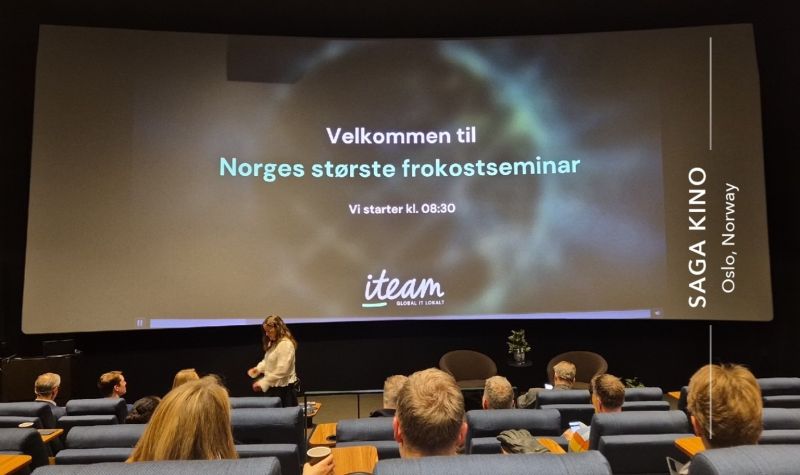
Yesterday I attended iteam and Michael Jacobs' breakfast seminar at Saga Kino in Oslo - an event with over 800 participants spread over 29 locations. The message was crystal clear: We are in a technological shift that requires a fundamental recalibration of how we lead, secure and scale businesses.
In the meeting, it was highlighted that the gap between those who only see AI as a tool, and those who understand it as a new commercial operating system, is increasing rapidly. Investing in deep AI understanding and change management now is not just an advantage, but a critical capability for any leader navigating the years ahead.
Here is my strategic summary of the most important drivers for 2026:
1. The technological paradigm shift
We have moved from the 90s focus on software to the 2000s cloud services. We are now entering the age of autonomous agents.
• From tool to digital workforce: AI is moving from being a passive assistant to becoming an active agent that automates routine tasks, analyzes huge data sets and supports strategic decisions.
• Global technology - local consequences: The technology is available to everyone, but the competitive advantage is created locally by those managers who are able to operationalize AI in their value chain.
2. Cyber security as a strategic foundation
Roar Thon from NSM delivered a grim reality orientation: The threat picture is characterized by state actors and organized criminals.
• Identity is the new attack surface: Attackers rarely hack systems. They log in via misused user identities.
• Broad security: A holistic approach requires control over technology, people and processes.
• Four critical capabilities: Any modern business must be able to prevent, detect, manage and normalize operations after an attack.
3. AI in operational practice: Microsoft Copilot
Daniel Horgmo from Microsoft demonstrated how we are moving from simple chat to actual autonomous agents that act as a digital workforce.
• Precise delegation: Success with AI requires “Prompting 101” – the ability to provide goals, context and sources as if delegating to a team member.
• Agent Mode: Through Copilot, we now see agents that perform multi-step tasks autonomously directly in our core systems.
My strategic conclusion:
I believe that success requires us to stop looking at security and AI as IT projects. Cultural and structural changes are needed.
• Start small, think big. Test on a small scale, but have a clear strategy from management.
• Data discipline: Good data and strict access management are the prerequisites for AI effect.
• Security by design: Integrate security from the start as it is significantly cheaper than dealing with a crisis.
Thanks to iteam for a professional deep dive into the future.
Relevant next steps
If you would like to discuss a related topic, feel free to get in touch.
Go to contact →