When AI gains more power – what should managers actually manage?
When AI affects decisions: who is responsible? EDGE, 5A and governance as management's response to increased autonomy.
Several managers I speak to describe the same dilemma:
AI is helping us more and more – but we're not quite sure where the limit is.
As AI moves from support to decision influence, a new managerial responsibility arises. Not technically. Not legal. But in terms of governance.
In the last posts in my AI series, and through experiences from my master's course at BI, I have written about AI agents. The common denominator is clear: the more decision-making power is moved from people to systems, the more important responsibility and control become.
In this post, I stop and zoom out. This becomes more of a framework and theory, because this is where many organizations lose track as AI moves towards decision influence.
The reasoning is largely based on Generative AI for Business by Shubin Yu, combined with patterns I see in managers in this transition.
As AI begins to influence decisions, one question always pops up in the executive room:
Who is really responsible when AI gets more power?
This is where governance comes in. Not as bureaucracy, but as management's response to increased autonomy. When AI affects decisions, the nature of managerial responsibility also changes: the question is not whether AI creates value, but where and within what framework.
To understand this, it is useful to clear up two frameworks that are often mixed up:
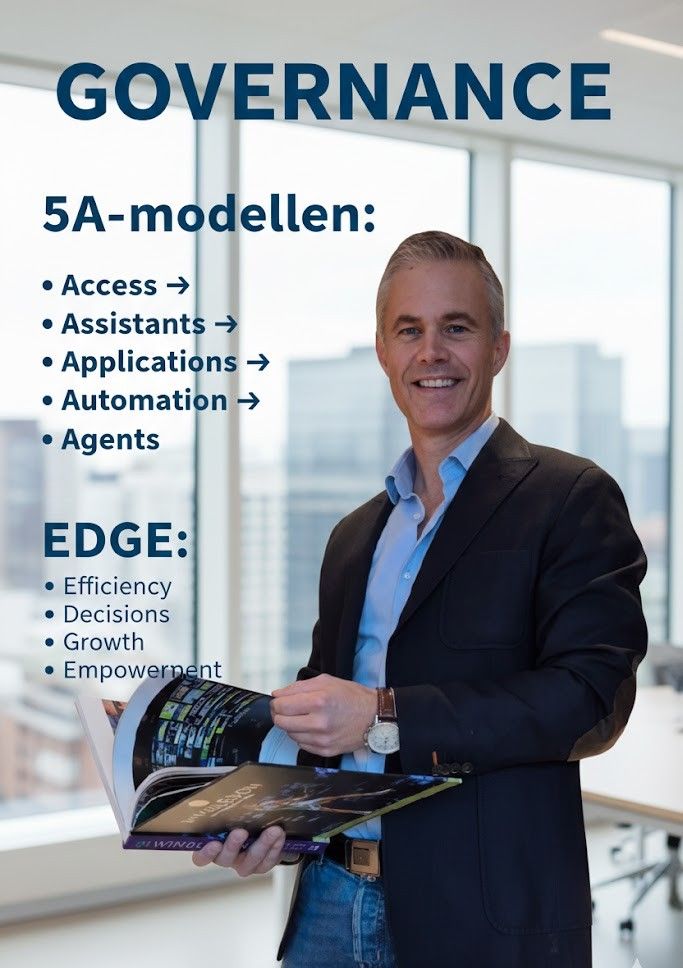
The EDGE framework describes where the value from AI is extracted:
• Efficiency – make existing work faster and cheaper
• Decisions – improve decision quality and timing
• Growth – develop new products, services and business models
• Empowerment – empowering people in complex roles
In parallel, the 5A model (Access → Assistants → Applications → Automation → Agents) shows the maturity journey in how AI is used. The higher up one moves, the more responsibility is shifted from individuals to systems.
Governance is not part of EDGE, but a superstructure that becomes crucial when AI is used at the Decisions level in EDGE and when the organization moves towards Automation and Agents in the 5A model. Without governance, pace and autonomy increase faster than responsibility and control.
In practice, AI governance is about basic management choices:
• Which decisions can AI influence – and which can it not?
• Who owns the consequences when recommendations are used?
• How do we stop, adjust or override the systems when reality changes?
In other words:
EDGE explains where the value lies.
5A explains the journey to maturity.
Governance determines whether this becomes a competitive advantage - or a risk.
Relevant next steps
If you would like to discuss a related topic, feel free to get in touch.
Go to contact →